Why Google Doesn’t Like Your Minimalistic Style Website Pages: Word Count Matters
BY THE DHM TEAM16 MIN READ
On this page, 15 sections
Google’s search algorithms consistently favor comprehensive content over minimalistic pages with low word counts. According to Ahrefs (2025), 91% of web pages get no organic traffic from search engines. Thin content is a main reason for this issue. If your beautifully designed, minimalist website does not show up in search results, the issue is likely not your design. Instead, it may be the depth of your content.
Minimalistic design philosophy often prioritizes visual cleanliness over textual substance, creating a fundamental conflict with how search engines evaluate and rank content. John Mueller from Google has often said that the quality of content matters. He believes that how deep and detailed the content is can influence how algorithms evaluate a page’s quality. This article explores why word count matters more than you think and how to find the sweet spot between design elegance and SEO performance.
Understanding Google’s Content Preferences: Why Minimalism Fails in Search
Google’s E-E-A-T guidelines (Experience, Expertise, Authoritativeness, Trustworthiness) fundamentally favor comprehensive content that demonstrates expertise through depth. The Search Quality Rater Guidelines clearly say that high-quality content must offer real value. This is especially true for YMYL (Your Money or Your Life) topics, where low-quality content does not meet user needs.
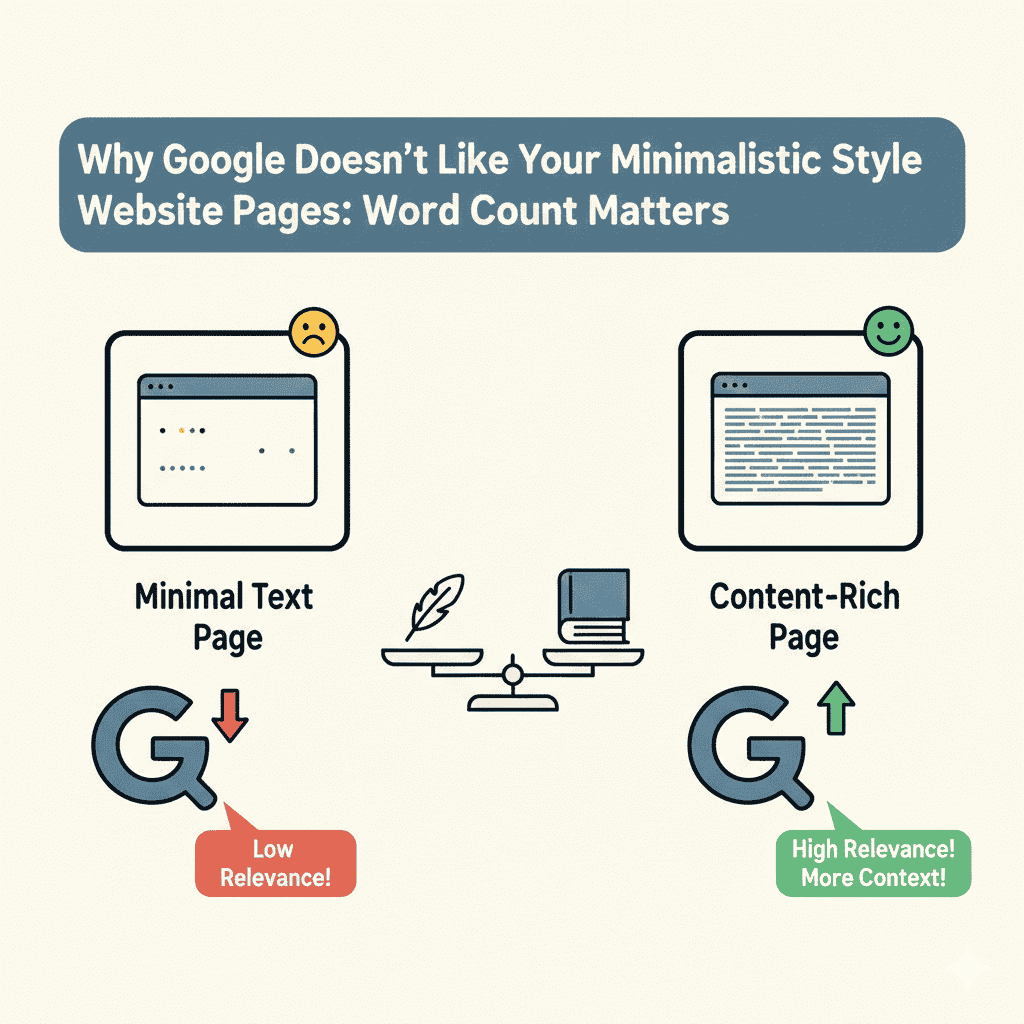
RankBrain and Google’s semantic search capabilities require context and depth to understand content relevance. When your page has only 150 words, search engines struggle to see your authority on the topic. They also find it hard to match what users are looking for. Google’s BERT and MUM models look at the meaning of words, not just exact keywords. They check if pages offer useful content, following the 2022 Helpful Content Update.
The distinction between visual minimalism and content minimalism matters significantly from an SEO perspective. A clean, well-structured design with ample white space can coexist with comprehensive content. The problem occurs when minimalism reduces word count. This can leave pages unable to answer search queries well or show expertise on the same topic as competitors.

Why Minimalistic Content Hurts Your Business Rankings
Research shows the correlation between content length and search rankings is substantial. Semrush analyzed over 1 million pages. They found that content longer than 2,000 words makes up 60% of high-traffic search results. Ahrefs studies show that top-ranking results average 1,447 words for competitive keywords. This is much more than the 100-300 words found on typical homepages.
The impact on organic traffic extends beyond rankings. User engagement metrics suffer when pages lack substance. The average time visitors spend on top-ranking pages is 3 to 5 minutes, according to Semrush data. In contrast, homepages with little content see visitors spending 45 seconds or less before leaving for other sites. In-depth content generally keeps users on a page longer, which signals to Google that the content is valuable. This poor user experience signals to search engines that your content fails to satisfy search intent.
When competitors outrank you with long-form content addressing the same topic comprehensively, the cost accumulates quickly. Longer content typically receives more social shares compared to shorter content. Lost visibility means missed leads, reduced brand authority, and diminished competitive positioning in Google search results.
The Content Length Sweet Spot: Finding Your Optimal Word Count
Finding the right minimum word count requires analyzing your specific industry and keyword competition. Tools such as Ahrefs Content Gap and Semrush’s Content Template offer helpful suggestions. They use data from top-ranking pages related to your target keywords. Longer posts have clear SEO benefits. They usually get more social shares and engagement on sites like X and Facebook. Additionally, content-rich pages often rank higher in search engine results.
| Content Type | Recommended Word Count | Primary Purpose | SEO Impact |
|---|---|---|---|
| Homepage | 400-800 words | Brand introduction, navigation | Moderate (supported by linked pages) |
| Product Pages | 800-1,500 words | Features, benefits, specifications | High for transactional intent |
| Blog Posts | 1,500-2,500 words | Informational, educational | Very high for organic traffic |
| Pillar/Guide Pages | 2,500-4,000 words | Comprehensive topic coverage | Maximum for topical authority |
| Category Pages | 300-600 words | Navigation, context | Moderate with internal links |
SEO tools recommend a minimum of 300–500 words per page to provide enough context for indexing as of 2026.
The sweet spot for most competitive keywords falls between 1,200-2,500 words based on Semrush’s 2024 study. Search intent is important. Informational queries usually need over 2,000 words. On the other hand, transactional keywords can do well with 800 to 1,500 words of quality content. Longer, well-structured content keeps readers engaged, which signals value to Google. Longer content can keep visitors on your site longer. This is a good sign for Google. Also, detailed content often gets more backlinks from other websites.
Keyword Research and Semantic SEO for Content Planning
Effective keyword research starts with understanding user intent behind search queries. Tools like Google Keyword Planner, Semrush Keyword Magic Tool, and Ahrefs Keywords Explorer help identify relevant keywords with appropriate search volume (aim for 500-5,000 monthly searches) and manageable competition.
Rank Math and Yoast provide real-time optimization guidance, helping identify content gaps and keyword opportunities within your existing pages. These tools check keyword density. It should stay between 0.5% and 2% for main keywords. This means you should mention them about 1 to 2 times for every 100 words. This helps you avoid over-optimization.
Semantic SEO practices extend beyond primary keywords. Build topical clusters using the hub-and-spoke model, where pillar content links to 20+ related articles covering subtopics. Natural LSI (Latent Semantic Indexing) integration helps you cover more topics. Google’s NLP automatically finds 15-20 related terms. This makes it important to address “People Also Ask” queries in your content strategy.
E-E-A-T and Content Authority
E-E-A-T requires substantial content to demonstrate. Experience demands real-world examples and case studies that short posts simply cannot accommodate. Expertise manifests through detailed explanations, technical depth, and demonstrating expertise through comprehensive coverage.
Building topical authority requires interconnected, in-depth content across your site. A single 200-word page cannot establish domain expertise, regardless of how well-designed it appears. Authoritative content cites sources, includes author bios with credentials, and provides unique value that other websites cannot replicate.
Trustworthiness signals emerge from transparent, detailed content that addresses user concerns thoroughly. YMYL topics particularly require 2x the content depth, per Google’s Search Quality Rater Guidelines. Quick answers work for featured snippets, but the supporting content must provide comprehensive context.
Real-World Brand Examples and Case Studies
Apple’s homepage exemplifies this paradox perfectly. The main page contains under 150 words focused on hero visuals and CTAs, seemingly thin content by any measure. Yet Apple ranks dominantly because its strategy separates design-focused landing pages from content-rich resources.
Apple’s newsroom (apple.com/newsroom) publishes 1,000+ word articles on product updates, generating approximately 70% of their organic traffic according to Semrush audits. This excellent example demonstrates how brands can maintain minimalistic front-ends while building topical authority through comprehensive blog content.
| Brand | Homepage Word Count | Blog/Content Hub | Traffic Distribution |
|---|---|---|---|
| Apple | ~150 words | 1,000+ word articles | 70% from blog |
| Aesop | Minimal product pages | 800-1,500 word guides | 40% from guides |
| Shopify | Minimal storefronts | 2,000+ word merchant guides | 55% from content |
| Patagonia | ~200 word product pages | 1,500+ word sustainability content | Majority from blog |
Patagonia uses simple product pages and detailed blog articles about sustainability. This strategy helps them rank #1 for “eco-friendly jackets.” They have over 50,000 backlinks to their in-depth content. This pattern repeats across successful minimalistic brands, the design stays clean while separate content hubs drive SEO performance.

Avoiding Duplicate Content: Protecting Your Site from SEO Penalties
Duplicate content is a common issue that can hurt your search engine optimization efforts. It can also damage your site’s credibility with search engines. When the same or similar content appears on different pages, it confuses search engines like Google. They struggle to choose which version to index and rank. This confusion can weaken your site’s authority. It may lead to lower rankings and even cause some pages to be left out of Google search results.
To safeguard your website, regularly check Google Search Console for duplicate content warnings and indexing anomalies. Use canonical tags to show the preferred version of a page. Also, use 301 redirects when needed to combine duplicate URLs. It is essential to create high-quality, unique content that provides real value to users. Avoid copying or slightly rewriting material from other sites. By managing duplicate content, you protect your site from SEO penalties. This helps your pages be seen as the main source in your niche.
The Power of Internal Links: Building Authority Beyond Minimalism
Internal links are a powerful but often overlooked tool in search engine optimization. This is especially true for websites that use a minimalistic design. By linking to other relevant pages on your website, you guide users to useful resources. This also helps search engines understand the structure and organization of your content. This is especially important for long content. Internal links can break up heavy information and guide readers to related topics. This improves user engagement and boosts SEO performance.
A strong internal linking strategy includes using clear anchor text. It connects to high-quality, relevant pages. Make sure every important page is easy to access from different parts of your site. Avoid using too many links. This can confuse users and weaken the SEO value of your links. It may also lead to a bad user experience. Instead, focus on creating a clear and easy-to-use network of internal links. This will help both your visitors and improve your site’s search engine optimization.
The Blog Strategy: How Content Marketing Saves Minimalistic Brands
Separate blog sections are crucial for minimalistic main sites seeking organic traffic. Your homepage can remain elegantly sparse while blog posts do the heavy lifting for search rankings.
Mailchimp’s approach proves particularly instructive. Their product pages maintain clean, conversion-focused design with minimal copy. Their marketing blog shares detailed guides that are over 2,000 words long. These guides cover email marketing, automation, and small business growth. This content brings in a lot of organic traffic and builds their authority on these topics.
Shopify follows the same playbook. Minimal storefronts for merchants coexist with extensive merchant guides and blog articles that drive 55% of their organic visibility. These content marketers understand that generating content through blogs complements rather than compromises minimalistic brand aesthetics.
Content marketing strategies that work for minimal design brands include:
- Publishing long-form content on related topics weekly
- Creating comprehensive resource centers linked from main navigation
- Developing downloadable guides that provide more value than on-page content alone
- Building more links through linkable, in-depth content assets
When launching a new site or rebranding, it’s important to plan for SEO continuity and update all relevant channels. Also, be sure to update and manage your social media accounts. This will help show new blog content and branding. A consistent online presence leads to maximum engagement.
Technical Implementation: Optimizing Minimal Sites for Search
Expanding thin content doesn’t require sacrificing design integrity. Accordion sections, expandable FAQs, and tabbed content allow comprehensive content to coexist with clean visual presentation. The content exists for search engines while users see streamlined interfaces.
Schema markup and structured data provide context that sparse copy cannot. Product schema, FAQ schema, and article markup help Google understand page purpose despite limited visible text. Rank Math and Yoast simplify implementation, with properly marked-up pages showing 30% higher rich snippet appearance rates.
Internal links become particularly important for minimal navigation structures. When main pages have limited content, using internal links to important pages can share authority. This also helps search engines understand the structure of your site. Every minimal page should link to relevant comprehensive content elsewhere on your site. When you have low-quality or irrelevant pages, think about redirecting them. Send users to pages with better content. This helps keep your SEO value and improves the user experience.
Mobile optimization for content-light pages presents additional challenges. Google’s mobile-first indexing means your simple pages must work well on mobile devices. They should also provide enough content signals. Core Web Vitals are important. They include LCP under 2.5 seconds, INP under 200 milliseconds, and CLS under 0.1. However, they only account for 10-15% of ranking factors, based on Google’s analysis. Site speed is very important. Faster-loading pages help with SEO and user experience. They also improve crawlability and can lead to higher search rankings.
Recommended article: What Is Technical SEO and Why Does It Matter?
Using Google Search Console: Monitoring and Improving Minimalistic Pages
Google Search Console is an indispensable resource for anyone looking to optimize minimalistic website pages for search engine performance. Search Console gives you detailed data about your site’s search results, impressions, and click-through rates. This helps you identify which pages are not performing well and understand the reasons why. For simple pages, it is important that every word adds value. The content must meet the needs of both users and search engines.
Utilize Google Search Console to find pages with low engagement. Look for high bounce rates or short average time on page. Focus on these pages for content improvements. Improve these pages by adding useful information. Include internal links to related content. Refine your messaging to better meet user needs. Additionally, monitor for indexing issues and submit updated sitemaps to ensure your site remains visible in Google search. By using insights from Search Console, you can improve your site’s SEO performance. This will help you provide a better experience for your audience.
Indexing Issues and Solutions: Ensuring Your Content Gets Found
Indexing issues can quietly hurt your search engine optimization efforts. They can stop your content from showing up in Google search results. Common causes include duplicate content, a poorly organized site structure, and insufficient high-quality backlinks. If search engines can’t easily crawl and index your pages, even the best content may go unseen by your target audience.
To fix indexing issues, begin by using Google Search Console. This tool helps you find out which pages are not indexed and the reasons why. Use canonical tags and 301 redirects to fix duplicate content. Also, reorganize your site so that all important pages are easy to find. Focus on creating high-quality, unique content that attracts more backlinks and signals value to search engines. Also, make sure your site works well on mobile devices. Improve the speed of your pages. Use HTTPS to help with search engine crawling and indexing. By actively managing these technical aspects, you boost the chances that Google will find and rank your content.
Content Audit and Optimization: Identifying Thin Content Issues
Start by using Google Search Console to identify underperforming pages. Review Google Search Console’s Coverage and Performance reports. Look for indexed pages with few impressions or clicks. These pages may have content quality issues. Thin content violates Google’s spam policies and can lead to penalties. Google’s crackdown on thin content began with the 2011 Panda algorithm update.
Screaming Frog and Ahrefs are site audit tools. They check the content depth on your site. These tools highlight pages that have fewer words than needed. A thorough site audit shows clear issues. Category pages have only 50 words. Product pages are missing specifications. Landing pages lack context. During your audit, be sure to find and remove scraped content. This is content copied from other sources without permission or credit. Address doorway pages as well. These are low-quality pages created to rank by stuffing in keywords or links.
Prioritize pages for content expansion based on:
- Search volume for target keywords
- Current ranking position (positions 11-20 offer quick wins)
- Revenue potential from improved visibility
- Competition level for relevant keywords
Create content expansion roadmaps that balance immediate opportunities with long-term topical authority building. Address thin content systematically rather than randomly: start with pages targeting your highest-value search queries. When expanding content, avoid unnecessary fluff and focus on enriching thin content with valuable information. The fastest way to improve thin content is to add value to each section. This ensures your content is not seen as thin and offers a good user experience. Keep in mind that pages with too many ads can lead to a bad user experience. Google understands the value of a good user experience and may penalize such pages.
Measuring Success with Google Search Console: Tracking Your SEO Progress
Tracking your SEO progress is essential for understanding what’s working and where there’s room for improvement. Google Search Console provides a complete set of metrics. These include search queries, impressions, click-through rates, and average position. This tool helps you track how well your site performs in Google search. By regularly checking these insights, you can spot trends. You will also see opportunities. This will help you make smart choices to improve your SEO strategy.
Combine Search Console data with Google Analytics. This will help you understand user engagement better. You can track metrics like time on page, bounce rate, and conversion rate. This complete approach helps you see how your site performs in search results. It also shows how visitors engage with your content. Use these insights to improve your current pages, create new quality content, and build strong internal links. This will help your website provide value and boost its SEO performance over time.
How Digital Hype Media Transforms Minimalistic Sites for SEO Success
Digital Hype Media approaches this challenge holistically for clients. We understand that design integrity matters while search performance drives business results. Our methodology balances aesthetic requirements with content strategy development that delivers measurable improvements.
Our process begins with comprehensive audits analyzing thin pages across client sites. We use semantic clusters by adding over 1,800 words per page. This helps with keyword density while keeping your brand voice and design principles intact. E-E-A-T signals strengthen through author bios, case studies, and demonstrable expertise.
Real client results demonstrate this approach’s effectiveness. One client improved their ranking from position 50 to position 5 for competitive keywords. They did this by creating 2,000-word pillar content. This led to significant traffic growth with few changes to their current site structure. We leverage Ahrefs, Semrush, and Rank Math to find each client’s content sweet spot.
Monthly article publishing reinforces topical authority, while ongoing optimization ensures content remains current, avoiding outdated information that undermines rankings after core updates.
View our Case Studies to learn more of our SEO Success.
Common Mistakes Minimalistic Sites Make
Prioritizing design over functionality and discoverability remains the most frequent error. A beautiful website that nobody finds through Google search provides limited business value. Search engine optimization must inform design decisions, not the reverse.
Many site owners misunderstand the difference between thin content and clean design. Comprehensive content can exist within elegant, well-structured pages. Visual minimalism and content minimalism are separate choices: successful brands embrace the former while avoiding the latter.
Neglecting blog content and content marketing opportunities leaves organic traffic potential unrealized. When your homepage contains 150 words, you need substantial blog articles, guides, and resources compensating for that brevity. Failing to create content beyond core pages means relying entirely on paid acquisition or direct traffic.
Additionally, many minimal sites fail to optimize for long-tail keywords and semantic search. Without comprehensive content, you cannot naturally incorporate the varied search queries potential customers use. Low-quality content or sparse pages simply cannot match the search intent diversity that long-form content addresses.
Ongoing Content Strategy: Maintaining SEO Performance
Monthly content audits identify pages requiring expansion, refresh, or consolidation. Duplicate content creates indexing issues, while outdated information undermines authority. Regular reviews prevent both problems.
Read more about Importance and Benefits of Monthly WordPress Site Maintenance
Monitoring competitor content strategies through tools like Semrush and Ahrefs reveals gaps and opportunities. When competitors publish detailed guides that outrank your basic pages, your response should be clear. Create content that offers more value, covers topics in depth, and aligns better with what users are looking for.
Balance new content creation with existing page optimization. Not every SEO improvement needs new blog posts. Sometimes, you can get faster results by expanding existing pages. Improving internal links or adding relevant information to thin content can also help.
Using artificial intelligence tools accelerates content creation while maintaining brand voice. AI assists with research, outlines, and initial drafts, but human expertise ensures content demonstrates genuine authority. Google’s search algorithms increasingly distinguish between generic AI-generated text and content reflecting real experience.

Conclusion: Building SEO Success Without Sacrificing Design
Word count is important for Google search rankings. It is not a direct ranking factor. Instead, it serves as a proxy for content quality, topical authority, and user satisfaction. Minimalistic pages with 100-200 words cannot compete against comprehensive content averaging 1,500+ words for competitive search queries.
The solution doesn’t require abandoning minimalistic design principles. Successful brands keep design-focused pages separate from content-rich resources. This approach helps maintain a strong visual appeal. At the same time, it boosts SEO performance through strategic blog content and detailed guides.
Actionable steps for minimalistic brands:
- Audit existing pages using Google Analytics and Search Console to identify thin content
- Develop a content strategy targeting realistic word counts for your keyword targets
- Build topical authority through interconnected blog articles and guides
- Implement proper internal links connecting minimal pages to comprehensive content
- Monitor search performance monthly and respond to ranking changes
Quality matters more than quantity, but sufficient quantity enables quality demonstration. When your pages lack substance, search engines cannot see your expertise. Competitors with better content will consistently outrank you.
Professional SEO guidance transforms minimalistic sites into high-performing digital assets. Finding the right balance between good design and search visibility is possible. It needs careful content planning based on data, competitor analysis, and effective SEO practices.
Written by Digital Hype Media’s SEO & Content Strategy Team, specialists in transforming minimalistic websites into organic traffic generators through holistic search engine optimization.
Reviewed & Edited by Muhammad Farhan Khan, Technical Lead, Digital Hype Media – San Diego