Why Email Automations Matter for Ecommerce Stores and How They Work
BY THE DHM TEAM13 MIN READUPDATED

On this page, 12 sections
Email automation generates 320% more revenue than standard broadcast campaigns according to Campaign Monitor research. For ecommerce businesses competing in saturated markets, this isn’t a marginal improvement. It’s the difference between sustainable growth and stagnation.
At Digital Hype Media, we’ve implemented email marketing automation systems for ecommerce stores across San Diego and beyond, witnessing firsthand how automated email campaigns transform customer relationships and revenue streams. Whether you’re running a Shopify boutique or a WooCommerce enterprise, understanding email automation fundamentals is essential for competing in today’s ecommerce landscape.
This comprehensive guide breaks down everything you need to know: what email automations are, the essential automation types every ecommerce store needs, platform comparisons between Klaviyo, Mailchimp, and FunnelKit, and real-world revenue data from brands that have published their results.
Understanding Email Automations: The Foundation of Ecommerce Revenue Growth
Email automation for ecommerce involves sending targeted, personalized emails to customers based on their behaviors, milestones, or predefined events, without manual intervention. Unlike traditional email marketing where campaigns are manually created and sent to entire lists, automated email marketing uses triggers that respond to customer actions instantaneously.
The fundamental architecture of any email automation platform consists of four core elements:
- Triggers – Customer behaviors that initiate email sequences (signup, purchase, cart abandonment)
- Conditions – Logical rules that determine which path a customer follows
- Actions – The specific automated messages or tasks executed
- Dynamic content – Personalized elements that adapt based on customer data
Modern automation platforms now incorporate AI and machine learning to optimize send times, predict customer behavior, and personalize content at unprecedented scale. These platforms analyze browsing behavior, purchase history, and engagement patterns to deliver the right message at precisely the right moment in the customer journey.
The technology operates continuously in the background, creating what industry practitioners call “set and optimize” functionality: workflows that run perpetually while you focus on strategy and growth rather than manual execution.
Digital Hype Media leverages advanced automation workflows through platforms like FunnelKit, Klaviyo, and custom GoHighLevel integrations, selecting the right marketing platform based on each client’s specific ecommerce platform, industry requirements, and growth objectives.
Why Email Automations Matter for Your Ecommerce Business
The revenue impact of email automation is substantial and well-documented across industry research. Omnisend’s 2023 Email Marketing Statistics Report reveals that automated emails drive 41% of email marketing revenue despite representing only 2% of total email sends. This efficiency ratio makes email automation the highest-leverage marketing activity available to most ecommerce businesses.
Consider these specific revenue implications:
- Cart recovery potential: Automated abandoned checkout emails recover 10-15% of otherwise lost sales according to Baymard Institute research
- Lead qualification: Businesses using email automation see a 451% increase in qualified leads according to the Annuitas Group
- Customer lifetime value: Strategic automation increases customer lifetime value by maintaining consistent engagement through the entire customer journey
- Operational efficiency: Automation reduces manual marketing workload by approximately 50%, freeing teams for strategy and optimization
Real brands have published impressive results. Beardbrand, the men’s grooming company, attributes significant revenue growth to their automated welcome series and post-purchase flows. MVMT Watches built a nine-figure business with email automation as a core revenue driver, using sophisticated abandoned cart sequences and personalized product recommendations.
For ecommerce store owners, the math is straightforward: automated campaigns work around the clock, personalizing at scale while you sleep. Every hour without automation represents potential customers lost and revenue left on the table.
Essential Email Automation Types for Ecommerce Success
The taxonomy of email automations represents distinct business use cases, each with different revenue implications and strategic purposes. Understanding these categories helps you prioritize implementation based on your current needs and resources.
Welcome Series Automations
Welcome emails have 86% higher open rates than standard promotional emails according to GetResponse’s Email Marketing Benchmarks report. This makes your welcome series the highest-engagement opportunity in your entire email marketing strategy.
A well-crafted multi-touch welcome sequence accomplishes several objectives:
- Introduces brand values and story to new customers
- Sets expectations for email frequency and content types
- Delivers immediate value through exclusive discounts or educational content
- Encourages customers to complete their first purchase
Glossier built their cult following partly through welcome emails that feel personal and authentic, introducing subscribers to their philosophy before pushing products. Allbirds uses their welcome series to communicate sustainability values, building customer loyalty before the first purchase even happens.
Best practices for welcome series optimization include sending the first email within minutes of signup, limiting the initial series to 3-5 emails over 7-10 days, and including a compelling call to action in each message that guides subscribers toward conversion.
Abandoned Cart and Browse Abandonment Flows
Abandoned cart recovery represents the most direct revenue opportunity in email automation. According to Moosend research, cart abandonment emails achieve 45% open rates with 21% click-through rates, dramatically outperforming standard promotional campaigns.
The distinction between cart and browse abandonment is important:
- Cart abandonment triggers when customers add items but don’t complete checkout
- Browse abandonment emails trigger when visitors view products without adding to cart
Browse abandonment captures 2.4% conversion rates versus 0.5% for standard emails, making it a high-value automation often overlooked by newer ecommerce businesses.
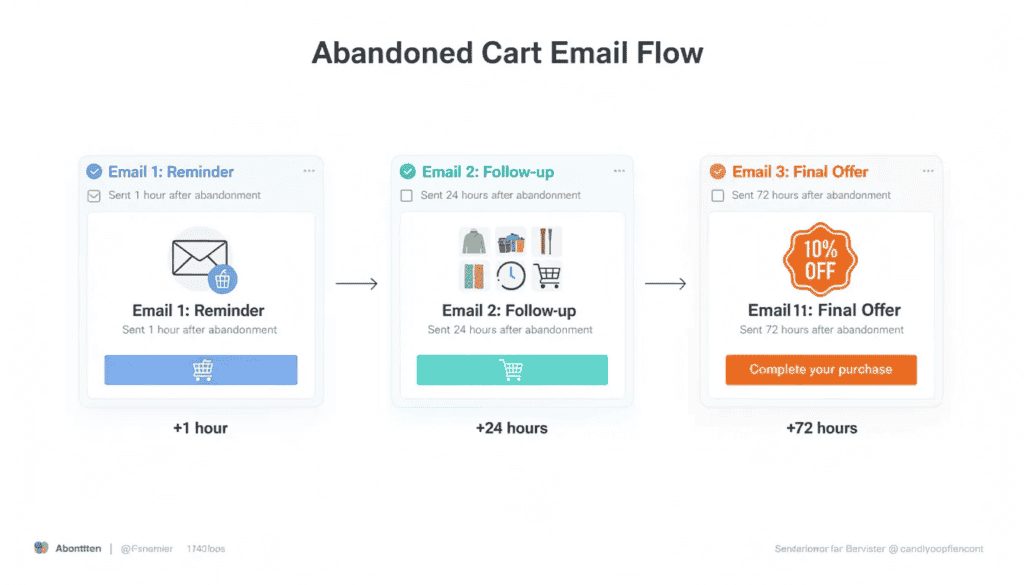
The optimal abandoned cart sequence typically includes three emails:
- Reminder email (1-4 hours after abandonment) – Remind customers about items left behind
- Value reinforcement (24 hours) – Include product images, customer testimonials, and social proof
- Incentive offer (48-72 hours) – Discount code or free shipping to recover lost sales
Fashion Nova and ASOS have both published case studies showing cart recovery rates exceeding industry averages through sophisticated personalized emails that dynamically display abandoned products with real-time inventory status.
Post-Purchase and Customer Lifecycle Automations
Post-purchase automation extends the customer experience beyond the transaction, building customer satisfaction and encouraging repeat business. This category includes:
- Order confirmation and shipping confirmation email – Transactional emails with upsell opportunities
- Delivery notifications – Real-time updates that reduce support inquiries
- Review and feedback requests – Gather feedback and generate social proof for SEO
- Replenishment flows – Automated reminders for consumable products based on typical usage cycles
The review request timing matters significantly: sending approximately 7-10 days after delivery (not purchase) ensures customers have experienced the product before you gather feedback.
Cross-sell and upsell sequences leverage purchase history to recommend complementary products. A customer who purchases running shoes might receive automated messages suggesting running socks, hydration accessories, or workout apparel, increasing average order value through data-driven insights rather than generic promotions.
Retention and Re-engagement Campaigns
Win-back campaigns recover 25% of dormant customers according to Mailchimp’s published data. These re-engagement emails target subscribers who haven’t opened emails or made purchases within defined timeframes.
Retention automation types include:
- Win-back sequences – Re-engage customers who haven’t purchased in 60-90+ days
- VIP and loyalty program emails – Reward loyal customers with early access and exclusive benefits
- Birthday and anniversary emails – Personalized messages that strengthen emotional connections
- Milestone celebrations – Recognize customer purchases anniversaries or spending milestones
Effective re-engagement campaigns often include escalating incentives, starting with brand reminders and culminating with exclusive discounts or special offers. The key is segmentation: different customer lifecycle stages require different messaging approaches.
Promotional and Seasonal Automation Flows
While promotional campaigns often run manually, strategic automation enhances their effectiveness:
- Holiday email campaigns – Pre-built sequences for Black Friday, Cyber Monday, and seasonal peaks
- Back-in-stock alerts – Notify potential customers when desired products return to inventory
- Price drop notifications – Alert customers who browsed specific products about price reductions
- Limited-time offer sequences – Create urgency with countdown-based automated messages
Geographic and demographic targeting enables localized promotions, ensuring customers receive relevant offers based on their location, previous purchases, and demonstrated preferences.
Email Automation Platform Comparison and Tool Selection
Choosing the right email automation platform significantly impacts both implementation complexity and long-term results. Here’s a comprehensive comparison of three leading options:
| Feature | Klaviyo | Mailchimp | FunnelKit Automations |
|---|---|---|---|
| Best For | Mid to large ecommerce | Small businesses & startups | WooCommerce stores |
| Shopify Integration | Native, real-time sync | Good, some limitations | N/A (WordPress only) |
| WooCommerce Integration | Strong | Moderate | Native, seamless |
| Pricing Model | Contact-based | Contact-based, tiered | One-time license |
| Learning Curve | Moderate | Low | Moderate |
| Advanced Segmentation | Excellent | Good | Very Good |
| Predictive Analytics | AI-powered | Basic | Limited |
Klaviyo: Enterprise-Level Ecommerce Automation
Klaviyo has emerged as the dominant email marketing automation platform for serious ecommerce businesses. Its deep integration with Shopify and WooCommerce enables real-time data sync, meaning customer behavior immediately informs automated email campaigns.
Key strengths include:
- Advanced behavioral segmentation based on purchase history and browsing behavior
- Predictive analytics that identify high-value potential customers
- Revenue-focused analytics with clear attribution modeling
- Pre-built automation templates optimized for ecommerce
Klaviyo case studies show clients averaging 35% increase in email revenue after implementation. The platform excels at using customer data to drive sales through personalized product recommendations.
The tradeoff is cost: Klaviyo becomes expensive as contact lists grow, making it most suitable for businesses with email revenue that justifies the investment.
Mailchimp: Small Business Automation Solution
Mailchimp remains the entry point for many e-commerce businesses beginning their email marketing journey. Its user-friendly interface and pre-built templates lower the barrier to launching automated campaigns.
Advantages for growing businesses:
- Intuitive visual workflow builder requiring minimal technical knowledge
- Competitive pricing at lower subscriber tiers
- Extensive third-party app ecosystem
- Free tier available for businesses just starting out
Limitations become apparent as businesses scale: Mailchimp’s segmentation capabilities and ecommerce-specific features lag behind specialized platforms like Klaviyo. Most businesses outgrow Mailchimp as their marketing efforts become more sophisticated.
FunnelKit Automations: WordPress and WooCommerce Specialist
For WordPress and WooCommerce stores, FunnelKit Automations provides native integration and advanced funnel building capabilities at a cost-effective price point.
Key features include:
- Seamless WooCommerce data integration without external syncing
- Visual workflow builder with sophisticated conditional logic
- One-time license model versus recurring subscription costs
- Complete funnel building including checkout page optimization
FunnelKit particularly appeals to businesses wanting full control over their automation infrastructure without ongoing platform fees. Digital Hype Media frequently recommends FunnelKit for WooCommerce clients seeking powerful automation without enterprise-level pricing.

Revenue Impact and Performance Metrics of Email Automation
The financial case for email automation rests on documented research across the industry. The Data & Marketing Association (DMA) consistently reports $36 ROI for every $1 spent on email marketing, the highest return of any marketing channel.
Specific automation revenue benchmarks include:
- Welcome series: 320% higher revenue per email than promotional campaigns (Campaign Monitor)
- Abandoned cart flows: 10-15% recovery rate on otherwise lost sales (Baymard Institute)
- Browse abandonment: 2.4% conversion rate vs 0.5% for standard emails (Moosend)
- Win-back campaigns: 25% reactivation of dormant customers (Mailchimp)
Attribution modeling remains critical for understanding automation’s true impact. Modern email automation platforms provide revenue attribution that tracks the complete customer journey from email click through purchase, enabling data-driven insights into which automations drive the most value.
The compound effect matters most: individual automations contribute meaningfully, but the combined impact of a comprehensive automation strategy multiplies results. An ecommerce store running welcome series, abandoned cart, post-purchase, and win-back automations simultaneously captures revenue at every stage of the customer lifecycle.
Real-World Success Stories and Case Studies
Published case studies provide valuable insights into automation strategies and their revenue impact:
Beardbrand documented their email marketing transformation in multiple interviews, crediting automated flows for significant revenue growth. Their welcome series emphasizes brand storytelling over immediate sales, building customer loyalty that translates to higher customer lifetime value.
Brooklinen, the bedding company, shared that email automation accounts for substantial portion of their email revenue. Their abandoned cart sequence includes personalized subject lines and dynamic product recommendations based on browsing behavior.
Marketing agencies have published client success stories with specific metrics:
- Klaviyo agency partners report average 30-40% revenue increases after implementing comprehensive automation strategies
- Email marketing specialists document 500%+ ROI improvements when replacing manual campaigns with sophisticated automated email marketing
The pattern across successful implementations is consistent: businesses that invest in strategic automation setup and ongoing optimization see dramatically better results than those using basic or template-only approaches.
AI-Powered Email Automation and Future Trends
Machine learning applications are transforming email marketing automation beyond simple trigger-response systems. Current AI capabilities include:
- Send time optimization: ML algorithms analyze individual subscriber behavior to determine optimal delivery times
- Predictive analytics: Identify customers likely to churn, make purchases, or respond to specific offers
- Content personalization: Dynamic content that adapts based on predicted preferences
- Subject line optimization: AI-generated personalized subject lines tested at scale
Integration with omnichannel customer experiences means email automation increasingly connects with SMS, push notifications, and emerging voice commerce channels. The future of customer engagement involves coordinated messaging across all touchpoints.
Privacy regulations including GDPR, CCPA, and emerging state-level laws impact automation strategies. Compliant data collection and consent management have become prerequisites for sustainable email marketing. Platforms that don’t prioritize compliance create legal risk for businesses.
How Digital Hype Media Delivers Email Automation Excellence
Digital Hype Media approaches email automation as a strategic business function, not just a marketing tactic. Our process begins with comprehensive analysis of your ecommerce platform, customer data, and revenue objectives.
Our implementation services include:
- Custom automation strategy development based on your specific business model and customer behavior patterns
- Platform selection and implementation matching the right automation tool to your needs and budget
- Ongoing A/B testing and optimization for continuous improvement in open rates, click-through rates, and conversions
- Integration with CRM systems and advanced customer data platforms for unified customer views
We build automations that increase customer engagement while respecting your brand voice and customer experience standards. Every sequence we create incorporates mobile optimization, compelling call-to-action elements, and personalized messages that resonate with your audience.
Specialized Solutions for Restricted Industries
Many ecommerce businesses operate in categories that mainstream email marketing platforms restrict or prohibit entirely. Research peptides, cannabis, CBD, and other gray market product categories face constant risk of platform shutdowns.
Digital Hype Media has developed specialized solutions for these businesses:
- Custom GoHighLevel integrations with WooCommerce and FunnelKit that bypass platform restrictions
- Brevo API implementation for email delivery independent of restrictive marketing platforms
- Compliant automation strategies that meet legal requirements while maintaining marketing effectiveness
- Backup system implementations ensuring business continuity if primary platforms face disruption
Rather than relying on any single automation tool that could shut you down, we architect resilient systems using API-level integrations that keep your email marketing running regardless of platform policy changes.
Email Automation Implementation Best Practices and Common Pitfalls
Successful automation implementation requires attention to both strategy and technical execution:
Data collection and segmentation strategies:
- Capture relevant customer data at signup and throughout the customer journey
- Segment based on behavior (purchases, browsing), demographics, and engagement levels
- Build progressive profiles that improve personalization over time
A/B testing methodologies:
- Test subject lines systematically: personalized subject lines typically outperform generic versions
- Optimize send times based on your specific audience behavior
- Test content length, product images placement, and call-to-action positioning
Mobile optimization requirements: With 60%+ of email opens occurring on mobile devices, mobile-first design is mandatory. This means single-column layouts, tap-friendly buttons, and concise copy that displays well on small screens.
Common mistakes that reduce effectiveness:
- Overcomplicating initial automations instead of launching and iterating
- Failing to suppress recent purchasers from abandoned cart sequences
- Ignoring deliverability factors that send emails to spam folders
- Not personalizing beyond basic name insertion
Measuring Success: Analytics and Continuous Optimization
Key performance indicators specific to email automation campaigns include:
- Revenue per email – Total revenue attributed divided by emails sent
- Conversion rate by sequence – Percentage of recipients who complete desired action
- List growth rate – New subscribers minus unsubscribes over time
- Customer lifetime value impact – Changes in CLV correlated with automation engagement
Attribution modeling tracks how automated campaigns contribute to overall ecommerce revenue. Most platforms provide revenue attribution, but sophisticated analysis requires integration with Google Analytics and ecommerce tracking systems.
Regular audit processes identify optimization opportunities. Digital Hype Media conducts monthly reviews of automation performance, testing new approaches and refining existing sequences based on data-driven insights.
Reporting should track trends over time, not just snapshot metrics. Understanding how automation performance evolves helps you make informed decisions about strategy adjustments and platform investments.
Getting Started: Your Email Automation Implementation Roadmap
Launching email automation effectively requires systematic prioritization. Here’s the recommended implementation sequence:
Phase 1: Foundation (Week 1-2)
- Configure email automation platform and ecommerce integration
- Set up basic segmentation based on purchase history and engagement
- Launch welcome series automation for new subscribers
Phase 2: Revenue Recovery (Week 3-4)
- Implement abandoned cart sequence (typically highest immediate ROI)
- Add browse abandonment emails for product page visitors
- Configure abandoned checkout emails with product images and social proof
Phase 3: Customer Retention (Week 5-8)
- Build post-purchase sequences including review and feedback requests
- Create replenishment flows for applicable products
- Launch customer win-back campaigns for dormant segments
Phase 4: Optimization (Ongoing)
- Implement A/B testing protocols for continuous improvement
- Expand automation with loyalty program emails and VIP sequences
- Add seasonal and promotional automations
Timeline expectations vary based on catalog size and complexity, but most ecommerce stores can have core automations running within 4-6 weeks of focused implementation.
Conclusion: Transform Your Ecommerce Revenue with Strategic Email Automation
Email automation represents the highest-leverage opportunity available to ecommerce businesses today. The data is unambiguous: automated emails generate dramatically higher engagement and revenue than manual campaigns, recover otherwise lost sales, and build customer loyalty that increases lifetime value.
The essential automations (welcome series, abandoned cart recovery, post-purchase flows, and re-engagement campaigns) form the foundation every ecommerce store needs. Platform selection between Klaviyo, Mailchimp, FunnelKit, or custom solutions depends on your specific requirements, budget, and technical capabilities.
Professional implementation matters significantly. The difference between basic automation and strategically optimized systems translates directly to revenue: businesses that invest in proper setup and ongoing optimization consistently outperform those using template-only approaches.
Digital Hype Media specializes in building email automation systems that drive sales for ecommerce businesses across industries, including specialized solutions for restricted product categories that mainstream platforms won’t support. Our San Diego team combines technical implementation expertise with strategic marketing knowledge to deliver automation that works.
According to Litmus, email marketing generates $42 for every $1 spent when properly optimized, but only 30% of businesses are maximizing this potential. The opportunity cost of delayed implementation compounds daily.
Contact Digital Hype Media to schedule a consultation and discover how strategic email automation can transform your ecommerce revenue.
Written by Digital Hype Media’s Web Development and Ecommerce Team, specialists in email marketing automation, ecommerce platform integration, and custom solutions for businesses requiring compliant marketing systems.